AEM 402/404 Senior Design • Project ORCA

Fixed-Frame eVTOL Reconnaissance UAV

ORCA is a fixed-wing eVTOL aircraft designed for runway-independent reconnaissance operations with modular payload integration, autonomous mission capability, and an end-to-end system design flow from CDR to build readiness.

My Role and Contributions

Team roles were distributed across aerodynamics, structures, propulsion, controls, and integration. My strongest contributions on ORCA were in CAD-heavy integration work, system packaging, technical outreach, and serving as the project pilot.

  • Supported full-airframe CAD iteration and integration alignment with subsystem teams.
  • Helped shape practical geometry decisions for manufacturability and assembly sequencing.
  • Contributed to design reviews and communication artifacts used in team presentations and project milestones.
  • Supported test-readiness activities and mission-oriented framing of the platform.

Executive Technical Snapshot

Mission and Performance Targets

  • Reconnaissance/ISR support with modular EO/IR payload capability
  • Cruise target: 17 m/s
  • Endurance target: 60 minutes (system goal)
  • VTOL hover target: 5–10 minutes with payload constraints
  • FAA Part 107 compliant operational envelope

Configuration Summary

  • Fixed-wing layout with distributed VTOL rotors
  • Approx. 1.33–1.40 m wingspan, ~1.0 m length
  • Modular nose payload architecture with fast swap intent
  • 3D-printed structure with reinforcement strategy
  • Battery-electric propulsion and integrated avionics stack

Engineering Design Maturity (CDR)

The CDR baseline reflected a mature, build-ready direction: aerodynamic refinement, propulsion trade convergence, updated structures validation, and integrated control-transition logic. The vehicle architecture and subsystem interfaces were advanced enough to proceed into fabrication and testing with reduced technical risk.

Important system updates included aerodynamic model refinement, manufacturability-focused geometry updates, and tighter integration between airframe layout and avionics/power distribution constraints.

Project Visuals

ORCA CAD perspective render showing fixed-wing body and VTOL arms
Early perspective CAD rendering used during integration reviews to validate subsystem packaging and wing/body geometry continuity.
Top perspective dark render of ORCA airframe
Top-oriented CAD view used to evaluate rotor placement symmetry, centerline geometry, and volume allocation for internal systems.
Top orthographic wireframe view with subsystem labels
Orthographic layout supporting integration planning across transition management, flight-control interfaces, and propulsion/power routing.
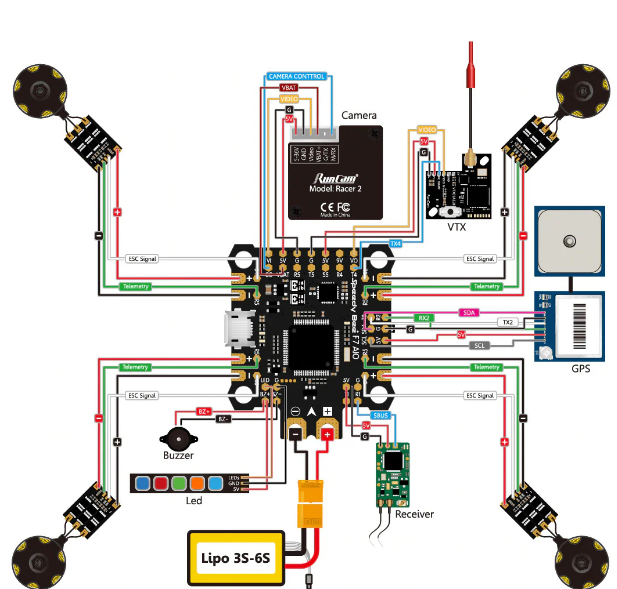
Avionics wiring schematic for flight controller, GPS, VTX, receiver, ESCs, and power
Electrical integration schematic showing avionics interconnects, telemetry paths, and power distribution architecture for VTOL-capable control.